
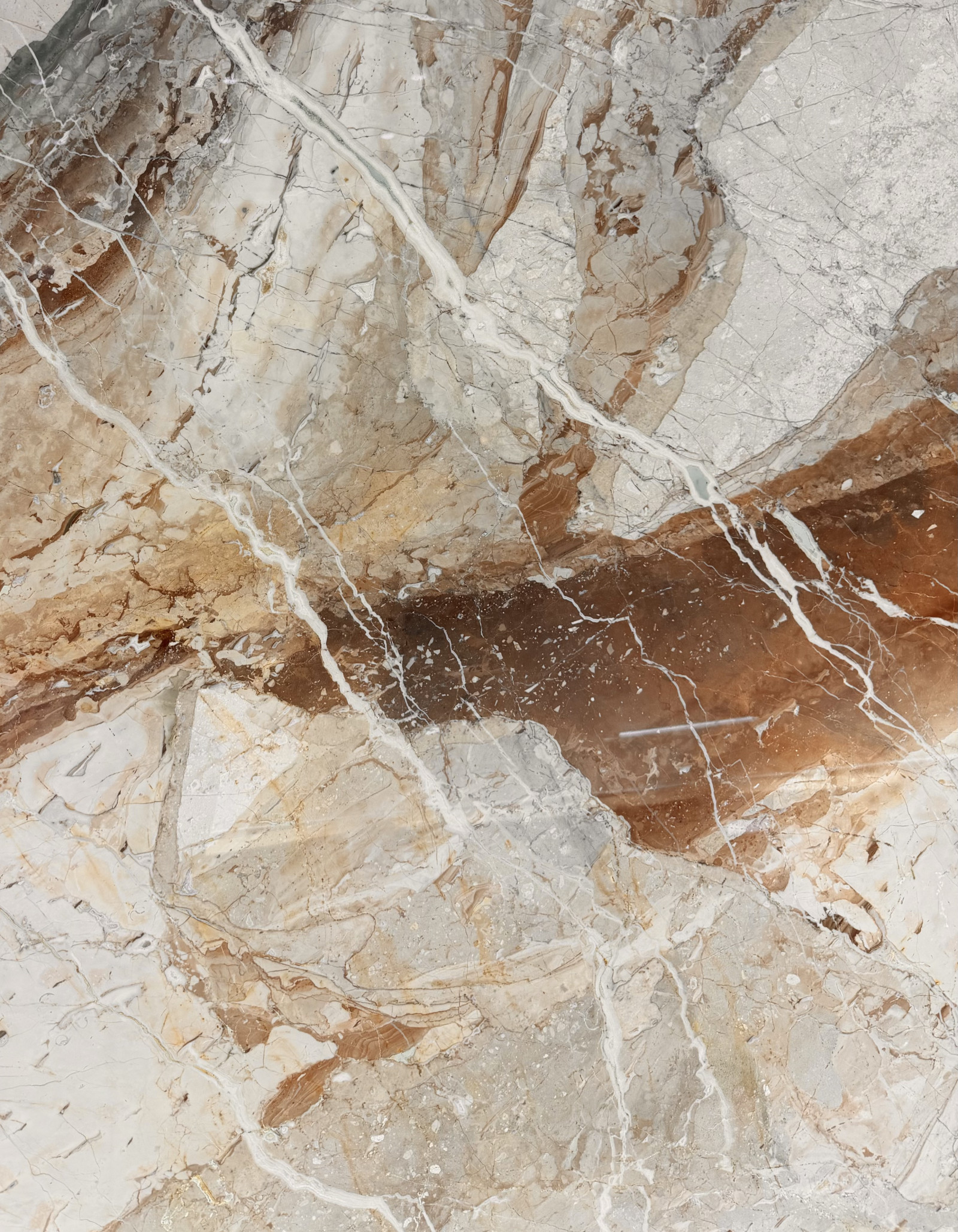
Most slab listings — ours included — compress a physical object into a short row of fields. Read them carelessly and two very different materials look interchangeable. Read them properly and you can usually tell, before writing a single message, whether a listing is worth an inquiry for your project.
This guide walks through the fields we publish on each slab page, what each one can reasonably be used for, and where a listing stops being evidence and a conversation has to begin.
Material type is the first filter, not the name
Commercial names travel further than geology. A stone sold as a 'green marble' in one market may be a serpentinite, a quartzite or a granite elsewhere, and the differences matter to your fabricator long before they matter to your client. Read the type field first and treat the name as a description of appearance rather than composition.
Where a listing says Marble, Quartzite, Granite, Dolomite or Onyx, that is the field we record and the one we will confirm in writing. If your specification depends on the material family — for edge detail, sealing, or a fabricator's cutting programme — quote the type and the code together in your inquiry, for example Calacatta Verde SWLZX9751 (Marble) rather than 'the green one'.
Finish changes the stone more than photographs suggest
Polished, honed and leathered surfaces of the same block read as different materials: polish deepens colour and sharpens vein contrast, honing flattens it, leathering adds texture that catches raking light. Our listings record the finish of the slabs as photographed. Where a project needs a different finish, ask — refinishing is a processing question with its own lead time and cost, not an attribute of the listing.
Origin tells you about supply, not quality
Origin is where the material was quarried — Brazil, Italy, China, Turkey, South Africa and so on. It is useful context for appearance and for how easily comparable material can be found later; it is not a grade. Two slabs from the same country, even the same quarry, can sit at opposite ends of a colour range. If continuity across phases matters, say so early: it changes which listings are worth reserving.
Dimensions and quantity: read them as a cutting problem
Each listing carries slab dimensions in millimetres — length, width and thickness — and a recorded piece count. Before inquiring, put those numbers against your largest single piece, not your total area. A 2,880 mm slab cannot produce a 3,000 mm island top regardless of how many pieces are listed, and a 17 mm slab will not satisfy a detail drawn for 20 mm without lamination.
Piece counts describe the bundle as last recorded, and material is consumed by other projects between updates. Treat the number as an indication of scale — whether this is a vanity-sized lot or a floor-sized one — and confirm the current figure before you build a schedule around it.
"A listing is a record of what was photographed and measured on a date. Current availability is a separate question, and it is always worth asking."
Status and date: a snapshot, not a live feed
Every slab page shows a status and the date it was last recorded: In Stock, Partially Sold, or Sold. Read them together. In Stock means the material was recorded as available on that date. Partially Sold means part of the lot has gone and the remaining quantity has to be confirmed before you rely on it. Sold listings stay published for reference — so that a material you liked can still be identified and comparable stone discussed — and are not offered for order.
The older the date, the more weight the confirmation carries. Nothing on the page is a reservation, and we would rather re-check a lot than let a specification rest on a stale line of data.
Bookmatch is a capability, not a guarantee of pairs
Where a listing is marked Bookmatch: Yes, the material has been recorded as bookmatch-capable — it was processed in a way that makes mirrored pairing possible. It does not confirm that a specific pair is currently standing together, in sequence, and unallocated. Which slabs are still paired, and in what order, has to be confirmed against the lot before you specify a mirrored feature wall or a waterfall return.
What to include when you inquire
The inquiries we can answer fastest and most usefully contain five things: the intended use (island top, vanity, feature wall, flooring), the largest finished piece size and overall area, the quantity or number of pieces required, the destination port or city, and a reference image or the slab codes you are working from.
With those, the reply can be specific: whether the recorded lot still supports the scope, what comparable material exists if it does not, and what would need to be checked physically. Without them, the exchange usually takes several rounds before anything useful can be said.
You can browse the individual listings in the slab library, work by colour and application through the material collections, or send a brief through the sourcing request form if you are still choosing between materials. All three lead to the same desk.
A short pre-inquiry checklist
Confirm the material type suits the application with your fabricator. Check the slab dimensions against your largest single piece, and the thickness against your details. Note the recorded status and its date, and ask for current availability. If the design depends on mirrored slabs, ask which pairs remain in sequence. Then send use, sizes, quantity, destination and a reference image — that is enough to get a considered answer rather than a price list.