
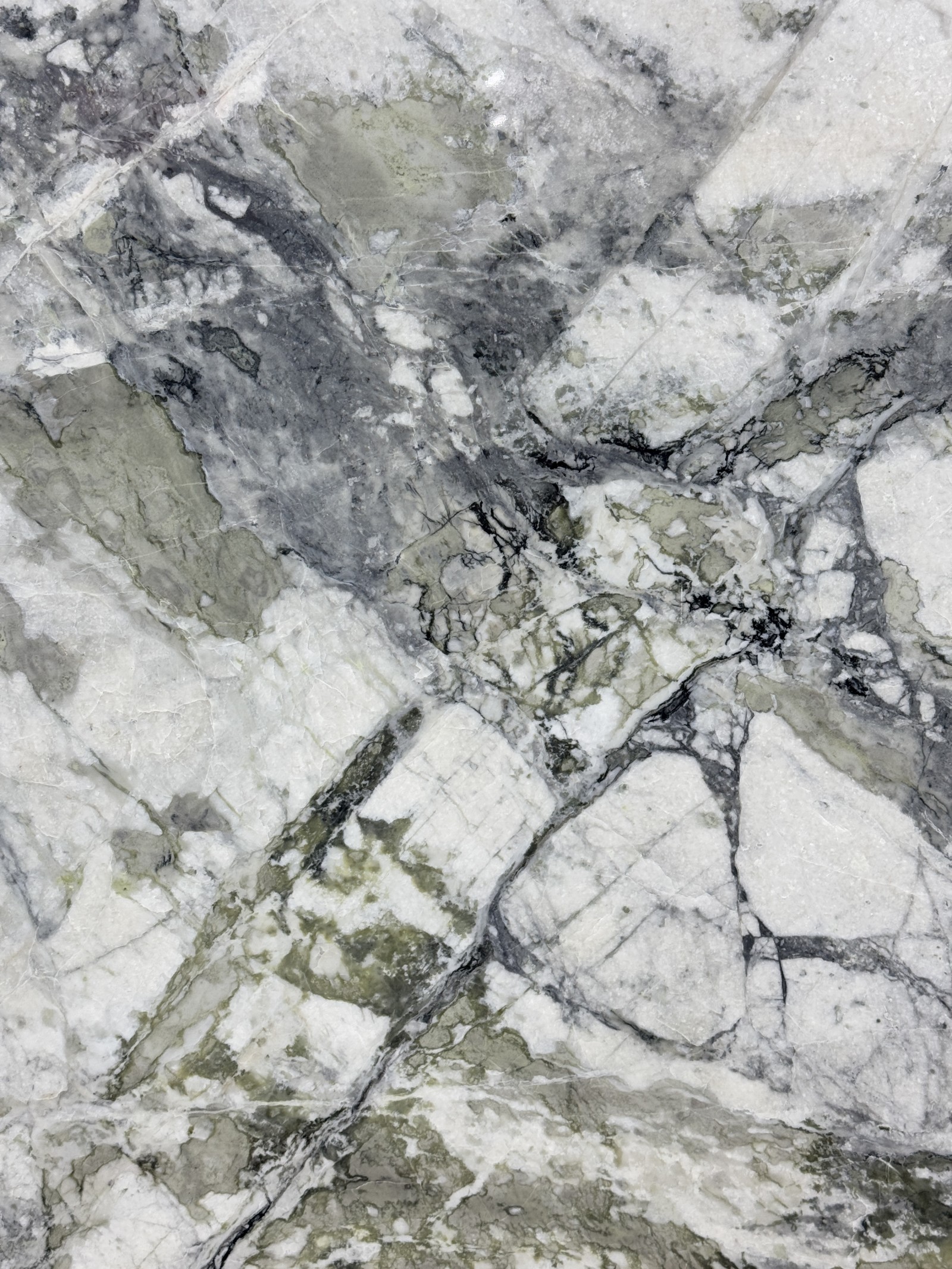
'Green stone' is a colour description, not a material category. The green slabs recorded in our library sit across marble, quartzite, granite, dolomite and stones traded under other names entirely. They are photographed the same way and priced in the same currency, but they are not selected the same way — and the first decision is which family you are actually specifying.
Start with the type field, not the colour
Our Green Marble collection is filtered on material type together with recorded colour or material name, so green quartzites, granites and other families are deliberately excluded from it. That is not a ranking; it is so that a specification written for marble is not filled from a quartzite listing by accident. If your drawing set says marble, browse the collection. If the family is open, browse the wider slab library and read the type on each listing.
Two listings make the difference concrete. Calacatta Verde SWLZX9751 is recorded as marble, quarried in China, polished, 2,900 × 1,870 × 17 mm. Gaya Green SWKLZ2225 is recorded as quartzite from Brazil, polished, 3,490 × 1,990 × 18 mm. They belong to the same colour conversation and to different fabrication conversations.
Read the colour register, not the word 'green'
Greens in our listings range from deep saturated tones to soft, pale and grey-leaning registers, and photographs of a polished surface exaggerate saturation. Verde Cipollino Extra SWTH44, an Italian marble recorded at 3,240 × 1,770 × 20 mm, reads through banded, layered movement; Calacatta Verde reads as a paler ground with defined veining. A stone described as green in a schedule can therefore land anywhere from a near-black feature wall to a quiet sage vanity.
When a scheme depends on the register rather than the name, ask for full-slab photographs of the specific lot and, where the scope justifies it, a physical sample. Vein direction and the scale of movement across a 3-metre slab are not reliably readable from a card-sized piece.
"Green is a register, not a material. Two slabs described the same way can behave completely differently at the saw."
Finish is a selection decision, not a detail
Our green listings appear in polished and leathered finishes. Polish deepens green tones and maximises vein contrast; leathered and honed surfaces mute saturation and change how the surface reads under directional light. Because our listings record the finish as photographed, a change of finish is a processing request with its own timeline — worth raising at inquiry stage rather than after approval.
Match the listing to the application
For kitchen work surfaces, discuss the specific material with us and with your fabricator before specifying it: density, porosity, sealing and maintenance vary between stones and between lots, and general claims about a colour family are not a substitute for that conversation. Our Kitchen Stone collection groups the listings put forward for island and countertop work, but the confirmation still happens per slab.
For vertical and low-contact surfaces — feature walls, fireplace surrounds, vanity fronts, reception faces — the selection question is mostly visual: slab size against the elevation, vein direction, and whether the design needs mirrored pairs.
Bookmatch, quantity and status
Several green listings are marked as bookmatch-capable. As with any material, that records a capability rather than a confirmed pair: which slabs are still standing together and in sequence has to be checked against the lot before a mirrored elevation is specified.
Quantities and statuses on each listing are a snapshot with the date it was last recorded. Where a green listing shows Partially Sold, the remaining quantity has to be confirmed before you plan around it. Sold listings remain published for reference only, so a material can still be identified and comparable stone discussed.
How to brief a green stone search
If you already know the slab, open its listing and send the code with your intended use, largest finished piece size, quantity, destination and a reference image. If you are still choosing between a marble and a quartzite, or between a deep and a pale green, send the same information through the sourcing request form and describe the register you are after — the reply can then compare the green listings currently recorded rather than guessing at a name.
Either way, the useful first message is about the surface you are building, not about price. What the stone has to do, how large it has to be, how much of it you need and where it is going is enough for a considered answer.